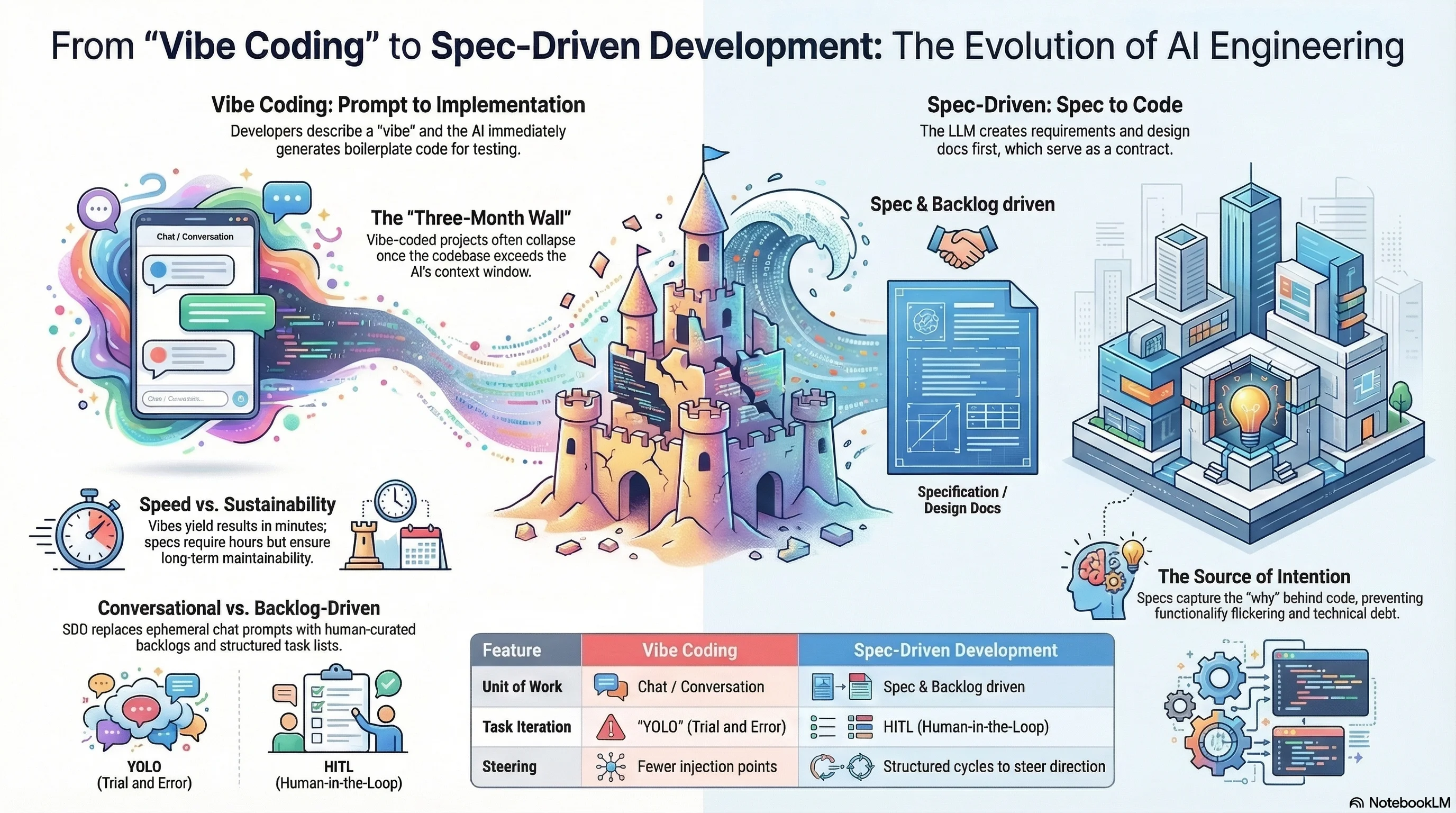
The Shift from Vibe Coding to Spec-Driven Development

Introduction
After a 2025 hot summer of vibe coding, the trend is shifting to Spec-Driven Development, after the industry realized that they can't escape planning and solution designing in the AI era. Vibe Coding, as attractive as it might seem, it attracts scalability issues, bad code smells and headaches to non-technical product developers.
Defining the Methodologies
Timeline and Workflow Evolution
Workflow Comparison
| Feature | Vibe Coding | Spec-Driven Development |
|---|---|---|
| Speed | Fast to results (minutes to hours) | Greater time investment (hours to days) |
| Unit of Work | Chat / conversation driven | Spec & backlog driven |
| Use of Context | Long & un-tended; prone to "context window" drift | Bound to the story; decisions written to the file system |
| Task Iteration | "YOLO" (speculative) | "YOLO" or Human-in-the-loop (HITL) |
| Predictability | Unreliable behaviors; difficult to debug | Specs ground design decisions & prevent endless refactoring |
Spec-Driven Development tools on the rise
The shift toward Spec-Driven Development (SDD) has led to the emergence of several specialized tools designed to prioritize structured requirements and architectural blueprints over conversational "vibes."
| Tool | Developer / Origin | Description and Key Features |
|---|---|---|
| Kiro | AWS | An agentic IDE built on Code OSS that makes spec-driven development and backlog generation a "1st-class citizen". It generates editable markdown requirements, design documents, and task lists before implementation. |
| Spec Kit | GitHub | A toolkit launched in September 2025 specifically designed to help developers with the Spec-Driven Development workflow. |
| BMAD Method | Open Source | A highly flexible and opinionated methodology that incorporates heavy iteration on specifications with a human-curated backlog. It allows for a choice of models and IDEs. |
| Codeplain | Third-party | Identified as an emerging tool aimed at bridging the gap between informal "vibing" and disciplined, structured building. |
| Tessl | Third-party | A tool recognized for adding necessary structure to AI-assisted coding to help prevent issues like "functionality flickering". |
Conclusion
Vibe coding and spec-driven development are not opposing forces but different tools for different stages of the creative process. While vibe coding provides the initial spark and momentum, SDD provides the guardrails necessary for enterprise-grade, sustainable software. As AI continues to reshape work, the most valuable engineering skill will be the ability to align a group on a vision and use AI to turn that ambition into clear, actionable specifications.